 The year that brought you the death of David Bowie, political upheaval and seemingly endless misery will last just that little bit longer - one second to be exact - to account for Earth’s slowing rotation.
The reason? Well it’s all to do with the fourth dimension - time.
The fluctuating speeds of our planet’s rotational spin mean that occasionally even the world’s
most precise clocks can end up out of whack with astronomical time - which is based on Earth’s journey around the sun.
These clocks inform Coordinated Universal Time (UTC), the globally recognized 24-hour timekeeping system since the 1960s, and are so precise in their measurements that they keep ticking on, regardless of the tiny changes of Earth’s rotation.
To combat this, the organization responsible for maintaining global time standards, the International Earth Rotation and Reference Systems Service (IERS), will add a ‘leap second’ to the last minute of 2016.
“A positive leap second will be introduced at the end of December 2016,” a notice on the IERS website reads.
Without periodically adding this extra second, UTC could eventually end up being really off-kilter, seriously impacting countries who base their days around the time scale.
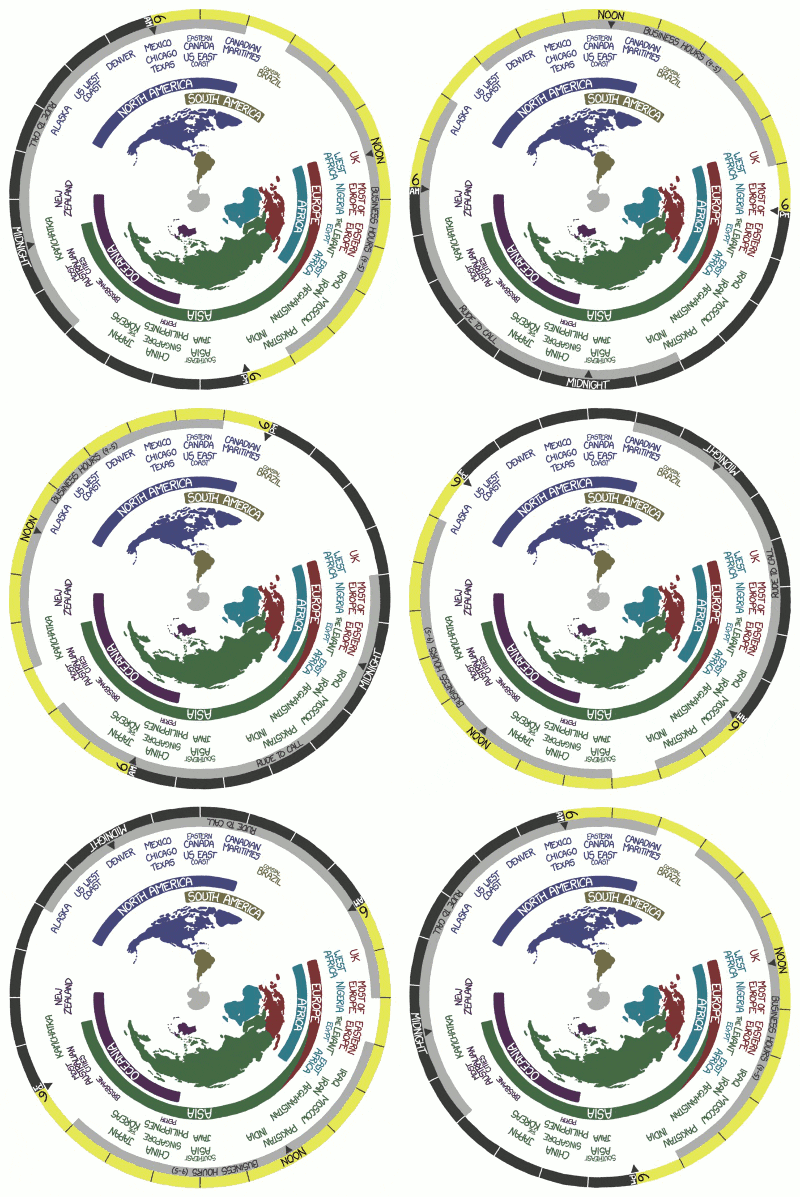
An article by Dr Markus Kuhn, senior lecturer in computer science at the University of Cambridge, explains that due to Earth’s gradually slowing trip around the sun the length of a day has increased approximately 2.5 milliseconds since the early 19th century.
He writes that the ‘leap second’ was first used in the 1970s following the introduction of UTC.
“Leap seconds have to be inserted on average every 1-2 years during this century,” Dr Kuhn says. “However, due to an unusual temporary acceleration of the Earth, no leap second was needed during the 17-year gap between the end of 1998 and the end of 2015,” he added.
A statement released to Phys.org by the Paris Observatory, from where the IERS operates, further details the practice: “This extra second, or leap second, makes it possible to align astronomical time, which is irregular and determined by Earth’s rotation, with UTC which is extremely stable and has been determined by atomic clocks since 1967.”
While the leap second may solve one problem, it also presents another.
In 2012, the additional second created havoc, causing websites unprepared for the change to crash. Australian airline Qantus was one of the businesses affected, experiencing scores of flight delays because of problems the leap second sparked with its check-in system.


No comments:
Post a Comment